
Anúncios
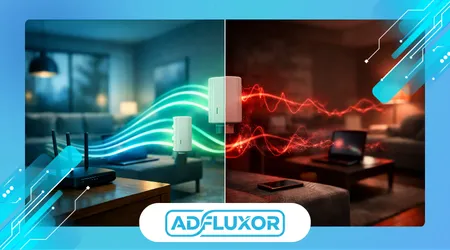
Wi-Fi extender problems often emerge when households attempt to fix coverage gaps without understanding how wireless signals degrade through walls, distance, and interference. This article examines when extenders improve connectivity and when they actively reduce network stability, speed, and reliability across real residential environments.
Many users assume Wi-Fi extenders function like simple signal amplifiers, but their operation involves complex retransmission behavior that can reshape traffic flows. Understanding these mechanics is essential to evaluating whether an extender will solve coverage issues or create new performance bottlenecks.
This analysis focuses on technical performance, user experience, and environmental variables that influence extender effectiveness in apartments, houses, and mixed-use spaces. It separates marketing promises from measurable outcomes observed in practical deployments.
The discussion compares extenders with alternative solutions such as mesh systems, access point wiring, and router repositioning. Each approach carries distinct tradeoffs in latency, throughput, and administrative complexity.
Real-world scenarios, including dense urban apartments and large suburban homes, illustrate how extenders behave under different interference conditions. These examples clarify why identical hardware can deliver opposite results in similar-looking setups.
Anúncios
By the end, readers will understand when extenders provide measurable value and when they degrade network performance. The goal is informed decision-making grounded in networking fundamentals rather than trial-and-error purchasing.
How Wi-Fi Extenders Actually Work
Wi-Fi extenders receive an existing wireless signal and rebroadcast it using the same radio spectrum. This process inherently divides available bandwidth because the device must listen and transmit sequentially on the same channel.
Most consumer extenders operate in half-duplex mode, meaning they cannot send and receive data simultaneously. Every retransmission adds latency, which accumulates rapidly under high traffic conditions.
Anúncios
Placement critically determines performance because extenders need a strong upstream signal to function effectively. Installing them in already weak zones forces them to amplify poor-quality data.
Many extenders create separate network identifiers, forcing devices to disconnect and reconnect when moving between coverage zones. This behavior disrupts real-time applications such as video calls and online gaming.
Dual-band extenders attempt to mitigate congestion by separating backhaul and client traffic. However, improper configuration often negates these theoretical advantages.
Environmental interference from neighboring networks directly impacts extender efficiency. In crowded radio environments, retransmission compounds packet loss and jitter.
Extenders do not increase internet speed beyond what the router provides. They only redistribute existing capacity across a larger area.
Firmware quality varies significantly among manufacturers, affecting roaming behavior and stability. Poor software design often causes more problems than radio limitations.
Understanding these mechanics explains why extenders deliver inconsistent results across different households. Their limitations are architectural, not user error.
++Ways Network Congestion Slows Down Connected Devices
Situations Where Extenders Actually Help
Extenders perform best in medium-sized homes where the router signal weakens due to distance rather than interference. Long hallways and stair-separated floors often benefit from strategic placement.
Homes with minimal neighboring networks provide cleaner radio environments for retransmission. In these cases, extenders can meaningfully expand coverage without severe speed penalties.
Single-user or low-concurrency households experience fewer downsides from bandwidth division. Light browsing and streaming tolerate added latency better than interactive workloads.
Older homes with thick walls sometimes benefit when Ethernet wiring is unavailable. Extenders can bridge difficult physical barriers when alternatives are impractical.
When placed halfway between router and dead zone, extenders receive strong upstream signals. This positioning maximizes retransmission quality and minimizes error correction overhead.
Some modern extenders support seamless roaming protocols that reduce device handoff disruptions. These features narrow the experience gap with mesh systems.
Temporary setups, such as rentals or short-term offices, benefit from extender simplicity. Quick deployment outweighs long-term efficiency concerns in these contexts.
Extenders can support low-bandwidth devices like smart plugs and sensors. These devices rarely saturate links or require low latency.
In controlled conditions, extenders offer acceptable performance improvements at minimal cost. Their value depends on realistic expectations and environment alignment.
When Extenders Make Network Performance Worse
In dense apartment buildings, extenders frequently worsen congestion by increasing channel utilization. Each retransmission occupies airtime already saturated by neighboring networks.
Bandwidth-heavy activities suffer because extenders halve effective throughput. Streaming multiple high-resolution videos quickly exposes this limitation.
Devices often cling to weak router signals instead of switching to stronger extender connections. This sticky behavior degrades performance unpredictably across rooms.
Gaming and video conferencing experience increased latency and jitter. These issues arise from retransmission delays rather than internet service limitations.
Extenders placed too far from routers amplify noise instead of usable signal. This placement increases packet errors and retransmission rates.
Security configurations sometimes fragment across networks, complicating device authentication. Misconfigurations can expose networks to unnecessary risks.
Poor-quality extenders introduce instability through overheating and firmware crashes. Budget hardware often lacks adequate thermal and memory management.
Network troubleshooting becomes harder because traffic paths multiply. Diagnosing slowdowns requires isolating extender-related variables.
In many cases, users attribute these failures to their internet provider. The real issue lies within local network architecture decisions.
++What Actually Causes Buffering During Streaming Sessions
Extenders Versus Mesh and Wired Alternatives
Mesh systems distribute traffic intelligently using dedicated backhaul links. This design avoids the bandwidth penalties inherent to simple extenders.
Wired access points provide the highest stability and throughput. Ethernet eliminates radio retransmission entirely from backhaul paths.
Cost considerations often drive extender purchases despite performance compromises. Mesh systems require higher upfront investment but deliver consistent results.
Installation complexity differs significantly between options. Extenders prioritize simplicity, while wired solutions demand planning and infrastructure.
Roaming behavior favors mesh architectures that manage client transitions centrally. Extenders rely on device-level decisions that vary widely.
The table below summarizes practical differences between common home networking approaches.
| Solution Type | Bandwidth Impact | Latency Behavior | Installation Complexity |
|---|---|---|---|
| Wi-Fi Extender | Reduced | Increased | Low |
| Mesh System | Minimal | Stable | Medium |
| Wired Access Point | None | Lowest | High |
Guidance from institutions like the Federal Communications Commission emphasizes interference-aware deployment. Their consumer advisories highlight limitations of signal repeaters.
Choosing the right solution depends on usage patterns rather than marketing claims. Performance consistency should outweigh convenience in long-term setups.
Environmental and Structural Factors That Matter

Building materials strongly influence wireless propagation. Concrete, metal, and brick attenuate signals far more than drywall or wood.
Floor layouts affect vertical signal travel differently than horizontal movement. Extenders struggle across floors without direct line-of-sight pathways.
Neighboring networks generate co-channel and adjacent-channel interference. This interference multiplies with each extender retransmission.
Household device density increases contention for airtime. Extenders amplify contention rather than resolving it.
Router placement often causes problems mistaken for coverage issues. Centralizing routers frequently reduces the need for extenders entirely.
Channel selection remains critical in congested environments. Automatic channel algorithms sometimes choose suboptimal frequencies.
Weather and external electromagnetic sources can introduce variability. These effects disproportionately impact marginal extender links.
Guidance from organizations such as the IEEE explains radio behavior under interference-heavy conditions. Their standards documentation clarifies why retransmission scales poorly.
Understanding physical context prevents misapplication of extender technology. Environment dictates success more than hardware specifications.
++The Difference Between Internet Speed and Real-World Performance
Making an Informed Decision Before Buying
Evaluating actual coverage gaps requires measurement rather than assumption. Signal mapping tools reveal whether issues stem from distance or interference.
Assessing device usage patterns clarifies tolerance for latency and throughput loss. Casual browsing differs fundamentally from real-time workloads.
Budget constraints must be weighed against long-term frustration costs. Replacing extenders repeatedly often exceeds mesh system pricing.
Future scalability matters as device counts increase. Extenders rarely scale gracefully with growing network demands.
Security considerations include firmware update policies and encryption consistency. Unsupported devices create hidden risks.
Vendor documentation and independent testing provide realistic performance expectations. Marketing materials rarely disclose tradeoffs transparently.
Expert consumer guidance from sources like Consumer Reports contextualizes extender performance across households. Their evaluations emphasize reliability over peak speeds.
Informed decisions align technology choice with environment and usage. Extenders remain tools, not universal solutions.
Conclusion
Wi-Fi extenders address specific coverage problems but introduce inherent tradeoffs. Their effectiveness depends on signal quality, placement, and interference levels.
They excel in limited scenarios where distance, not congestion, causes weak coverage. In these cases, performance sacrifices remain manageable.
In crowded environments, extenders frequently worsen network conditions. Retransmission amplifies congestion and latency beyond acceptable thresholds.
Understanding extender mechanics prevents unrealistic expectations. They redistribute bandwidth rather than create additional capacity.
Alternative solutions often deliver superior consistency. Mesh and wired systems solve structural problems extenders cannot overcome.
Cost considerations should include long-term usability, not initial price alone. Cheap fixes often produce expensive frustrations.
Environmental analysis must precede hardware purchases. Building materials and neighboring networks dictate outcomes.
Network planning remains the most effective optimization strategy. Simple repositioning sometimes eliminates the need for extenders.
Technical literacy empowers better connectivity decisions. Informed users avoid blaming external services for local design flaws.
Extenders remain situational tools, valuable when used correctly and harmful when misapplied. Clarity replaces trial and error.
FAQ
1. Are Wi-Fi extenders bad for internet speed?
Wi-Fi extenders reduce effective speed by retransmitting traffic on the same channel. The impact becomes noticeable during high-bandwidth or concurrent usage scenarios.
2. Do extenders work better than signal boosters?
Extenders and boosters share similar limitations because both retransmit signals wirelessly. Neither increases total available bandwidth from the router.
3. Can extenders cause connection drops?
Yes, especially when devices fail to roam smoothly between networks. This behavior interrupts sessions during movement across coverage areas.
4. Is placement more important than brand?
Placement has greater influence than brand specifications. Poor positioning undermines even high-quality extender hardware.
5. Do dual-band extenders solve congestion issues?
Dual-band designs help only when configured correctly. Many users fail to separate backhaul and client traffic effectively.
6. Are extenders suitable for gaming?
They generally degrade gaming performance due to added latency. Competitive gaming benefits more from wired or mesh solutions.
7. How long do extenders typically last?
Hardware lifespan varies, but firmware support often ends sooner. Unsupported devices become unstable and insecure over time.
8. Should extenders be used in apartments?
Apartments rarely suit extenders due to interference density. Mesh systems usually provide better reliability in such environments.